
The Implementation Gap: When Teaching Reform Meets Classroom Reality

By Peter Howes, Principal of Ballina Coast High School, New South Wales
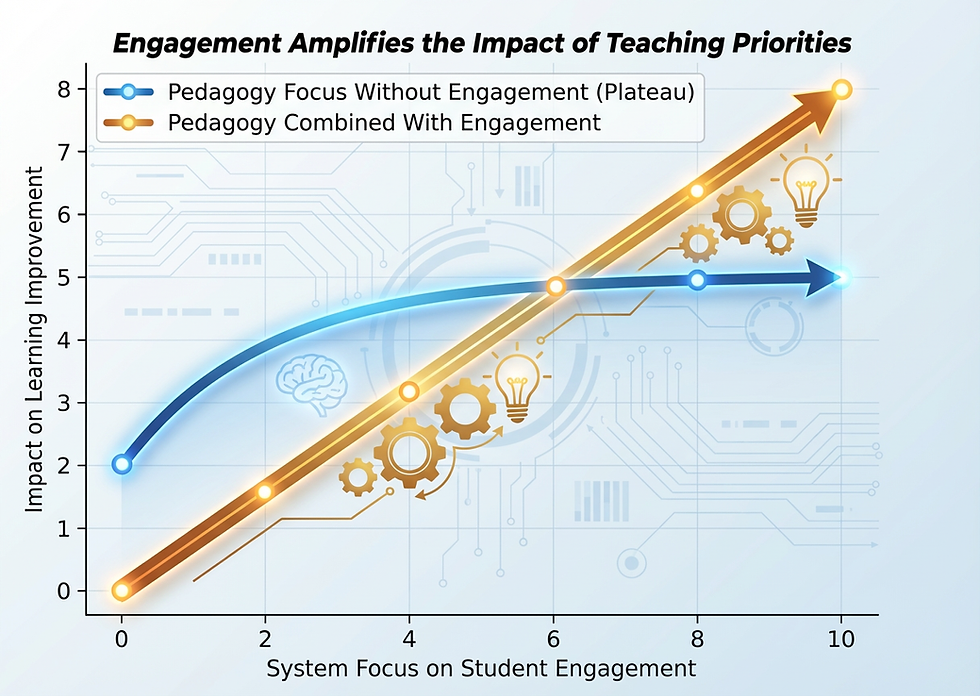
When reform priorities accumulate faster than schools can absorb them, the gap between policy ambition and classroom reality widens, leaving principals to find ways to bridge it.
It’s period three on a Wednesday.
A teacher stands in front of thirty students.
Most principals could describe a classroom that looks something like this:
Seven students require learning adjustments.
One arrived upset after a difficult night at home.
Another refuses to open their laptop.
Two highly capable students have already finished the task.
Several others are quietly disengaged, another not so quiet has their back turned.
Two students have not brought their laptop or a pen.
The teacher is expected to deliver the curriculum, implement evidence-informed pedagogy, maintain behaviour expectations, navigate the emerging complexities of artificial intelligence in learning, ensure student wellbeing, and ensure every student learns.
In some schools, teachers and leaders are also responding to a growing number of serious behavioural incidents. Across Australia, principals are increasingly managing situations involving aggression, threats and violence in ways that were far less common a decade ago. These incidents are not the daily experience of every classroom, but their frequency and seriousness are increasing in enough schools that leaders now factor them into how they think about engagement and learning.
Most teachers do this extraordinarily well. But principals across Australia know the reality:
In many classrooms today, engagement is the condition that allows learning to begin.
The reform paradox
Across the country, education systems are investing significant effort into improving teaching and learning.
We want stronger literacy and numeracy outcomes. We want evidence-informed teaching. We want equity of opportunity for every student. These are worthy ambitions.
But there is a growing issue many principals recognise, not because the reforms are wrong, but because of what happens when they land in schools.
It is the implementation gap: the space between system ambition and what schools have the time, conditions and professional capacity to enact in classrooms.
When systems underestimate that gap, reforms that are technically sound can still deliver far less impact than expected.
The students who most need the system to succeed are often the ones most affected.
Making the gap visible
This raises an important question for the profession. How do education systems actually measure the implementation gap between reform ambition and classroom reality?
And when that gap becomes visible to those leading schools every day how does the profession draw it to the attention of system leaders in ways that lead to change?
Large systems move slowly. Policy cycles rarely align neatly with the lived complexity of schools.
But if principals wait for systems to fully recognise the implementation gap on their own, the risk is that reform continues to accumulate faster than schools can absorb it.
The gravitational pull of pedagogy
In response to persistent equity gaps and declining international measures, many systems have sharpened their focus on pedagogy.
Clarity matters. Evidence matters. Strong teaching matters. But a subtle shift can occur. Sometimes systems move from the language of supporting pedagogy to prescribing pedagogy.
Teachers rarely rely on a single instructional approach. Effective classrooms draw on a repertoire that may include explicit instruction, inquiry learning, culturally responsive practice, trauma-informed approaches and student voice suited to the need of their students and context of their school communities. Principals see this every day.
Pedagogy matters enormously. But pedagogy does not operate in isolation from the students sitting in front of the teacher.
The compounding weight of worthy priorities
At the same time, we are responding to an expanding list of system priorities.
Across Australia these often include literacy and numeracy improvement, disability inclusion, high-potential education, wellbeing and mental health, Aboriginal education, attendance and engagement, student voice, workforce sustainability and the list goes on.
Each priority addresses a genuine challenge and each priority matters.
But together they create implementation density.
Large education systems are increasingly aware of the need to reduce workload for teachers and school leaders. That awareness is welcome. The difficulty is that systems also carry multiple policy agendas at once. Even when initiatives are well designed, they are not always complementary.
The result is something principals experience every day. It is not reform fatigue. It is reform congestion.
Schools rarely struggle with effort; they struggle with attention. When attention is stretched across competing reforms, the work of strengthening engagement becomes harder to sustain.
In some jurisdictions structural changes also shape the professional time available for implementation. In New South Wales, for example, recent teacher award negotiations have limited meeting time outside school hours to one hour per week. The intent to protect teacher workload is positive and overdue, but it also reduces the time schools have available for collaborative professional learning, capacity building, strategic planning and practice required to successfully implement the multiple priorities.
Many principals would describe the resulting tension simply: the ambitions of reform remain high, while the practical space to enact them continues to shrink. Leaving us in the implementation gap.
The missing variable: engagement
One insight principals consistently raise is that many reforms assume classrooms where students are ready and able to engage with learning. Increasingly, that assumption does not always hold.
In communities experiencing socioeconomic disadvantage, the challenge can be particularly complex and acute. Students may arrive at school carrying stress, instability or unmet needs that affect their readiness to learn. We are also seeing a decline of ‘deep engagement’ from students who are from more advantaged backgrounds who are perceiving what we are offering in school to be less relevant to their needs than ever before.
This does not mean expectations should be lowered, quite the opposite. But it does mean recognising a simple truth:
Engagement is the condition that allows learning to begin. Principals see this dynamic play out repeatedly in schools.
When engagement is fragile, even strong teaching reforms struggle to gain traction.
Engagement is not an alternative to teaching improvement. It is what enables teaching improvement to work.
Why principal agency matters
Principals sit at the intersection between system policy and classroom reality.
Strong principal agency allows us to adapt priorities to local contexts, integrate multiple initiatives into coherent strategies and respond to the complex needs of the students we serve.
Principals are not resisting improvement. We are working to ensure improvement is possible. Principals are cognisant that reform ultimately does not succeed in strategy documents. It succeeds in classrooms. And in those classrooms a teacher still stands in front of thirty young people each with their own story, their own challenges and their own potential. Before any pedagogy can take hold one important question permeates:
Are students engaged enough for learning to begin?
Ensuring that principals have a seat at the table with system decision makers allows the realities of learning and engagement in schools to inform how reforms are designed and implemented. There is a critical role for our professional associations, but also for individual principals to help socialise the challenges of the implementation gap.
Perhaps part of our role is not only to lead improvement within our schools, but also to help make the implementation gap visible, calmly, professionally and persistently, so that reform ambition and classroom reality can move closer together.
Peter Howes is Principal of Ballina Coast High School in northern New South Wales. He leads the Learning and Engagement Reference Group for the NSW Secondary Principals’ Council, is President of the SPC North Coast region, and is a member of the SPC Equity Reference Group.


While having https://visamastercardcasino.com open in another tab, that Wednesday classroom snapshot really hit home—the teacher juggling seven adjustments, a distraught student, and two finished early is basically every lesson I’ve ever taught. The way you frame engagement as the precondition rather than the goal makes me wonder if system leaders ever sit in on a period three before stacking another priority onto the pile. That implementation gap isn’t just about time; it’s about the sheer cognitive load of holding thirty different realities at once.
I found this really relatable, especially the point about reform congestion. Schools can have good ideas on paper, but putting them into busy classrooms is another matter. The same need for careful work applies when choosing Phd proofreaders for academic writing.